
Showing posts with label john lennon. Show all posts
Showing posts with label john lennon. Show all posts
Tuesday, January 3, 2012
Cee-Lo changes lyrics to John Lennon's "Imagine;" misses point
(link via DaisyDeadhead )
On NBC's New Years Eve show, singer Cee-Lo covering John Lennon's classic "Imagine" changed its most noted line, ""Nothing to kill or die for, And no religion too" to "Nothing to kill or die for, And all religion's true." Lennon fans were not happy.
And to be honest, I'm not either. Not because I think anyone's art is so untouchable, or any one artist (even Lennon) should be held to such idolatrous standards, but because nullifies the original meaning. Cee-Lo missed the point. Injecting religion into things that specifically call-out religion's hold on society, and the problems created in its name, makes me extremely uncomfortable. Yeah, he twitter-apologized (which has since been removed), and he probably thought his intentions were good, but ugh. No.
Monday, December 19, 2011
Earworm of the Day: John Lennon - Happy Xmas (War is Over)
I generally don't "do" Christmas songs. I don't celebrate, nor do I assume everyone reading this is a christian (or even a secular fan of yule); however, I think this song is on a lot of people's minds today.
Monday, October 10, 2011
John Lennon, Patti Smith, and the N-word
 |
| Last.fm |
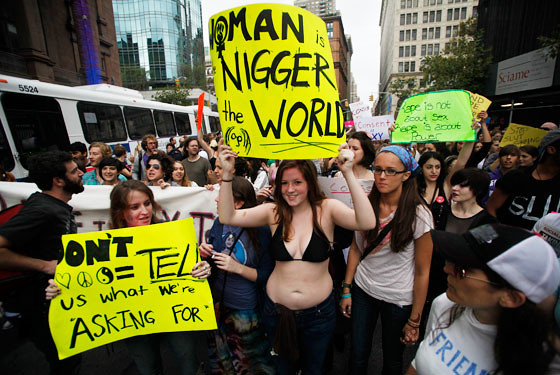
(I have nothing add other than to tell my fellow white feminists that it doesn't matter what the intent was. If something is racist, it's racist. There's no defending it, and I'm incredibly disappointed in those out there who insist on defending it.)
When I first saw that photo, I knew exactly what it was referring to: the John Lennon/Yoko Ono song of the same name. I assume the sign maker thought she was being clever, and since the N-word was in the title of a well-known song written by one of the most critically acclaimed songwriters of the last fifty years, it must be sanctioned. It must be okay.
Except it's not.
And if you have any reason to question why it's not okay, just read Latoya Peterson's post :
But can you appropriate a term like [n-word] if your body is not defined/terrorized/policed/brutalized/diminished by the word? Can we use it in a context that is supposed to belie gender solidarity, without explicitly being in racial solidarity?John Lennon would have turned seventy-one yesterday. In light of what's happened, it feels wrong writing a post that praises him. The song itself was recorded almost forty years ago, and peaked at #57, making it Lennon's lowest charting single to date. The single pulled in Britain and banned from the airwaves. In an article for PopMatters last year, Rachel Johnson said:
Although Lennon contended on The Dick Cavett Show that usage had ‘changed’the song actually returns the word to its awful origins: a viciously racist term intended to denigrate and dehumanize. Used politically to express identification and alignment with oppressed people of color, it is then universalized to underscore the condition of all women everywhere. Of course, the moral and artistic right of non-black men and women- particularly those gifted with power and privilege- to use such a word and to further imply that white women have been as equally victimized as black people throughout history may be questioned if not damned.Patti Smith used similar reasoning defending her song, "Rock and Roll N-word." In the liner notes she "frames it as a badge of honor for anyone 'outside society'" (source ), while ignoring its historical context. Sadly, critics overlook it also. I could find very few bona fide criticisms of that song within the many things written about her, and I say this as a long-time Patti Smith fan. However, her appropriation of that word is inexcusable. That goes for Lennon, too.
I wish there were more discussion around this, and other artists who think it's their right as an artist to use anything within their grasp without thinking how their power, their privilege, hurts others.
Sunday, December 12, 2010
Belated John Lennon Post (On the 30th Anniversary of His Death)
I've been toying with this for the past few days. How can you possibly sum up someone so iconic, someone whose life and influence is so stupefyingly huge, in a single blog post that probably no one will read? How do you do that when you're probably the one person on the planet without that "connection" -- that flashbulb moment when time stopped and you cam remember where you were, what you were doing, wearing, feeling when it happened.
I was seven-years-old when John Lennon died. I have no memory of this other than the timeline would suggest I was in second grade at the time, and if I concentrate hard enough, I can vaguely recall playing outside in the short alley between my house and the one next to it, and it was cold. I have no idea why this comes to mind. Maybe it's been conjured up by thirty years of "Where were you when it happened?" Everyone my age or older has an answer but me. Like this writer from Glorious Noise:
It wasn't a Beatles song that resonated with me, though. It's was John's solo, "Working Class Hero." I hate to be reductive, but I was drawn to it, at least in part, because it was the first song I heard somebody drop the "F-bomb in song." It was so deadly serious. According to a 1970 Rolling Stone interview, Lennon himself says the song is about "working class individuals being processed into the middle classes, into the machine." No one was tackling issues of class and culture when I was growing up. At least not in popular music when I was growing up -- it was all "You're only human," and "Express yourself." In the you-can-do-anything 80s, no one was willing to expose that lie. It was more than a decade old song, but I got it.
I was seven-years-old when John Lennon died. I have no memory of this other than the timeline would suggest I was in second grade at the time, and if I concentrate hard enough, I can vaguely recall playing outside in the short alley between my house and the one next to it, and it was cold. I have no idea why this comes to mind. Maybe it's been conjured up by thirty years of "Where were you when it happened?" Everyone my age or older has an answer but me. Like this writer from Glorious Noise:
I was but a child when I heard that John Lennon was dead. It was a cold morning in Michigan and I was at the breakfast table when my mom told me he’d been killed the night before. For the rest of the day—and much of the week—his songs were on every radio I passed. His voice calling out through the speakers and from beyond this earth. (Derek Phillips)I've written before, on what would have been John Lennon's 70th birthday, about my not having grown up with the Beatles. It's some sort of sacrilege to be child of a pair of baby boomers and not grow up with the Beatles, but my blues and country loving parents gave up pop music long before I was born. I had to discover them on my own. And I did at the ripe old age of thirteen. (Through the Monkees, no less.)
It wasn't a Beatles song that resonated with me, though. It's was John's solo, "Working Class Hero." I hate to be reductive, but I was drawn to it, at least in part, because it was the first song I heard somebody drop the "F-bomb in song." It was so deadly serious. According to a 1970 Rolling Stone interview, Lennon himself says the song is about "working class individuals being processed into the middle classes, into the machine." No one was tackling issues of class and culture when I was growing up. At least not in popular music when I was growing up -- it was all "You're only human," and "Express yourself." In the you-can-do-anything 80s, no one was willing to expose that lie. It was more than a decade old song, but I got it.
Thursday, October 14, 2010
To Yoko (on John's 70th Birthday)
John Lennon would have turned 70-years-old last Friday.
I'm just barely old enough to remember when he was murdered. John's was the first rock star death to have affected me in a way I could comprehend, "Oh, somebody great has died." I'm not sure, as a seven-year-old, how much I knew about the Beatles' legacy. My parents weren't fans (which is pretty shocking for a two people born smack in the center of the baby boom years); their music wasn't played at our house, but it was so omnipresent it didn't need to be. John was a cultural icon whose influence had already been felt throughout popular music as he was standing on the precipice of middle age. And then he was gone. There's really nothing more I can say about a man who quite literally changed history, so I won't. Instead I want to talk about Yoko, his widow.
Growing up in the years after John's death, Yoko Ono was, more than anything, a punchline. A succubus. A witch. The person responsible for breaking up the Beatles, leading half its creative head down a path of drugs and ultimately turning him into a house husband. I had never heard her music nor seen her art, and I was taught to dismiss her as a caterwauling non-talent. It pissed me off, and I stealthily defended her, though I didn't exactly know what she had done, aside from wedding a Beatle. What I didn't know then was that I was getting my first taste of feminism. Yoko wasn't as "stand by your man," kind of gal or rather she was, but she was more a "stand with your man" as equals and co-creators. That scared people.
Cara from The Curvature wrote a wonder three-piece feminist analysis on Yoko (which you can read here, here, and here) that delves deeper into her history that I ever could:
"The common story of women manipulating their male partners comes from the perception that these women are not supposed to do anything with their time except think about their man. It simultaneously ignores and depends upon the fact that women would of course not have to manipulate their husbands if they had equal power and autonomy in the relationship. Because Yoko had, on a personal level, equal power in her relationship with John, the assumption simply was that she could have obtained an equal status in no way other than manipulation. John couldn’t have enjoyed being a househusband. He couldn’t have just respected Yoko as a person. She couldn’t just be financially smarter than him. And god, he couldn’t possibly have actually liked that dreadful music and art of hers! The only explanation was that somehow, she had to be tricking him."
I would see this trope played out again after Kurt Cobain's death, with Courtney Love pegged as Generation X's Yoko. It's almost jokingly easy to draw parallels. And for someone still trying to navigate her was through feminism's third wave, when we were supposed to be past all this witch-hunting, it was a sobering reality that we hadn't come as far as we thought.
I'm just barely old enough to remember when he was murdered. John's was the first rock star death to have affected me in a way I could comprehend, "Oh, somebody great has died." I'm not sure, as a seven-year-old, how much I knew about the Beatles' legacy. My parents weren't fans (which is pretty shocking for a two people born smack in the center of the baby boom years); their music wasn't played at our house, but it was so omnipresent it didn't need to be. John was a cultural icon whose influence had already been felt throughout popular music as he was standing on the precipice of middle age. And then he was gone. There's really nothing more I can say about a man who quite literally changed history, so I won't. Instead I want to talk about Yoko, his widow.
Growing up in the years after John's death, Yoko Ono was, more than anything, a punchline. A succubus. A witch. The person responsible for breaking up the Beatles, leading half its creative head down a path of drugs and ultimately turning him into a house husband. I had never heard her music nor seen her art, and I was taught to dismiss her as a caterwauling non-talent. It pissed me off, and I stealthily defended her, though I didn't exactly know what she had done, aside from wedding a Beatle. What I didn't know then was that I was getting my first taste of feminism. Yoko wasn't as "stand by your man," kind of gal or rather she was, but she was more a "stand with your man" as equals and co-creators. That scared people.
Cara from The Curvature wrote a wonder three-piece feminist analysis on Yoko (which you can read here, here, and here) that delves deeper into her history that I ever could:
"The common story of women manipulating their male partners comes from the perception that these women are not supposed to do anything with their time except think about their man. It simultaneously ignores and depends upon the fact that women would of course not have to manipulate their husbands if they had equal power and autonomy in the relationship. Because Yoko had, on a personal level, equal power in her relationship with John, the assumption simply was that she could have obtained an equal status in no way other than manipulation. John couldn’t have enjoyed being a househusband. He couldn’t have just respected Yoko as a person. She couldn’t just be financially smarter than him. And god, he couldn’t possibly have actually liked that dreadful music and art of hers! The only explanation was that somehow, she had to be tricking him."
I would see this trope played out again after Kurt Cobain's death, with Courtney Love pegged as Generation X's Yoko. It's almost jokingly easy to draw parallels. And for someone still trying to navigate her was through feminism's third wave, when we were supposed to be past all this witch-hunting, it was a sobering reality that we hadn't come as far as we thought.

Subscribe to:
Posts (Atom)