
Showing posts with label 60s. Show all posts
Showing posts with label 60s. Show all posts
Saturday, July 7, 2012
Earworm of the Day: The Kinks - Death of a Clown
2012 is shaping up to be the year of "dude rock" -- at least in my world.
In the past couple weeks, I've added not only the Kinks, but the Stones, Springsteen (see below), and some favorites from the late 90s like Wilco and the Old 97s to my iPod. I've always listened to "dude" music, but trying to write about music from a feminist lens above everything else has relegated a lot of it to "guilty pleasure" status. And while I know it's possible to like un-feminist (or at least, not explicitly feminist) things without having to turn in your lady card. it does feel hypocritical to write about someone like Beth Ditto or JD Samson and when I'm done listen to the same music, well, my dad does.
The Kinks: The contrarian's choice for the "Beatles or Stones" question. Artistically, I'd go with The Beatles while the drunken Karaoker in me picks the Stones. But the Kinks fascinated me in a way that neither of those two did. They were so patently British, which contributed to their less than stellar popularity stateside, and vulnerable in an unnamable way -- at least compared to Lennon's obvious ennui and Mick's posturing.

Thursday, March 1, 2012
Davy Jones, R.I.P.
I'm cashing in my cool chips. I'm a huge Monkees fan. Yes, I know they were never a "real" band, and I really only saw them second fan via Nickelodeon's repeated airings. I'm a card-carrying member of the Monkees fan club (really!) and their 1986 reunion tour was my first concert (and apparently I'm not the only one ). Weird Al, whom at the time I found vaguely disturbing, opened. For those keeping score, Mike Nesmith, the one conspicuously absent from the reunion tours, is my "intellectual" favorite, while Peter Tork is my "sentimental" favorite. Needless to say, I'm incredibly sorry to hear that Davy Jones, the cute one who played the tambourine and won Marcia Brady's heart, died yesterday of a heart attack at age 66:
Jones was born in Manchester, England and started acting as a child. In 1964 he had the misfortune of appearing in the cast of Oliver! on the same episode where the Beatles made their debut. The next year he was cast in The Monkees, a comedy show/band inspired by the success of the Beatles. They were an instant hit in the ratings and the record shops, scoring massive singles with "Last Train To Clarksville," "I'm A Believer," "Stepping Stone" and "Pleasant Valley Sunday." Jones – who played tambourine in the band – was the lead vocalist on the classics "Daydream Believer" and "I Wanna Be Free." At the peak of their popularity in 1967 they sold more albums than the Beatles. (Rolling Stone)To be honest, I'm a little surprised by the outpouring of grief from women in their thirties and early forties. The Monkees were part of my mother's generation, and, I thought, my dirty little secret when everyone else was into Madonna or Bon Jovi. But then I remembered how often they were on TV in the mid-to-late eighties, an era didn't really have a lot of boy bands or teen idols. Of course we channeled them from another era. R.I.P. Davy.
Thursday, December 1, 2011
Youtube Find of the Day: Odetta and Johnny Cash
I usually find some of the greatest stuff on YouTube by coincidence. I was looking for some older Odetta clips, which are few and far between even in today's archival culture. I did, however, stumble upon this old clip of Odetta on the Johnny Cash show from 1969. Here's the info provided:
Odetta on "The Johnny Cash Show," August 30, 1969. The first song she performs is based on a Negro "field blues" song known simply as "Black Woman," then duets with Cash on "Shame And Scandal In The Family," which was written by a calypso artist who went by Sir Lancelot, in the 40s.
Monday, June 21, 2010
Women of Nuggets: Nancie Mantz and Annette Tucker
I had intended to write a post about women as bandmates in 60s garage rock, but after a search through Nuggets, the bible box set of psychedelica, proved fruitless, I noticed Nancie Mantz and Annette Tucker turned up a couple times in the credits as songwriters:
"Nancie Mantz was a songwriter whose 1960s work in collaboration with Annette Tucker helped jump-start the psychedelic punk boom and, 15 years later, became one of many flash points for the paisley underground. Mantz was principally a lyricist, trained on piano, guitar, and violin but proficient on none of them. Her focus was words, and she was good enough as a song-poet to get signed to Four Star Publishers in the early '60s -- her collaborators there included the company's head, Dave Burgess, and 1960s Crickets member Glen D. Hardin, as well as a young composer with bigger aspirations named Harry Nilsson. She collaborated with Hardin and Nilsson, among others, and had some successes with Keith Colley ("Human Kindness," "Ladder of Success") and with Burgess ("He's a Big Deal"), but it was when she was teamed with Tucker that some very interesting lightning seemed to strike. Tucker had gotten a band called the Electric Prunes signed to a company owned by engineer turned producer Dave Hassinger, who had gotten them a contract with Reprise Records and now needed some songs that could be potential hits. In the interim, Tucker had presented her with the proposed title "I Had Too Much to Dream (Last Night)," which the pair knocked off as a finished composition in less than an hour." (Answers.com)
What makes this kind of unusual, especially in light of Rolling Stone's recent update to their 500 Greatest Songs where women feature prominently, if at all, singing songs penned (overwhelmingly) by men. This flips the script, and produced probably one of the most well-known songs to come out of that era.
And for good measure, "I Had Too Much To Dream" covered by Wayne/Jayne County:
"Nancie Mantz was a songwriter whose 1960s work in collaboration with Annette Tucker helped jump-start the psychedelic punk boom and, 15 years later, became one of many flash points for the paisley underground. Mantz was principally a lyricist, trained on piano, guitar, and violin but proficient on none of them. Her focus was words, and she was good enough as a song-poet to get signed to Four Star Publishers in the early '60s -- her collaborators there included the company's head, Dave Burgess, and 1960s Crickets member Glen D. Hardin, as well as a young composer with bigger aspirations named Harry Nilsson. She collaborated with Hardin and Nilsson, among others, and had some successes with Keith Colley ("Human Kindness," "Ladder of Success") and with Burgess ("He's a Big Deal"), but it was when she was teamed with Tucker that some very interesting lightning seemed to strike. Tucker had gotten a band called the Electric Prunes signed to a company owned by engineer turned producer Dave Hassinger, who had gotten them a contract with Reprise Records and now needed some songs that could be potential hits. In the interim, Tucker had presented her with the proposed title "I Had Too Much to Dream (Last Night)," which the pair knocked off as a finished composition in less than an hour." (Answers.com)
What makes this kind of unusual, especially in light of Rolling Stone's recent update to their 500 Greatest Songs where women feature prominently, if at all, singing songs penned (overwhelmingly) by men. This flips the script, and produced probably one of the most well-known songs to come out of that era.
And for good measure, "I Had Too Much To Dream" covered by Wayne/Jayne County:
Thursday, April 8, 2010
Retro Read: Bubblegum Music: The Nake Truth by Kim Cooper and David Smay
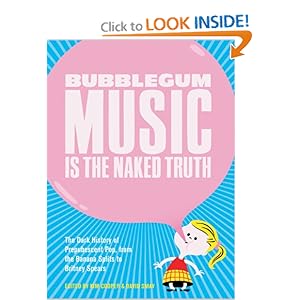
Of course, the 60s weren't all hippies and love-ins. The younger siblings, and the children of older baby boomers were cutting their teeth on sugary AM radio pop. At first I was hesitant to read Bubblegum Music, thinking it would be teeming with hipster irony, but it's actually a pretty cool homage to all those songs that should qualify as "guilty pleasures." (A concept I refuse to embrace. If it gives you pleasure, don't feel guilty. Own it.) There are a lot of fun, sometmes serious, essays here about bubblegum pop ranging from the 60s through the late 90s, including one really funny conversation about The Monkees. (Full disclosure: I am a huge Monkees fan.) It's aged surprisingly well, too (the book was written a decade ago.) The chapter, "1999: The Year Bubblegum Snapped," is just waiting for the next generation's misty-eyed nostalgia.
Subscribe to:
Posts (Atom)