Given the past two posts about the demise of Google Reader and Digg's foray into the world of RSS readers, I thought I should say something about web usability. The reason I publish the full feed here is because I prefer to read blogs through a reader or some other third party that I can control. I know that's not going to garner me many fans, and yes, I'm probably stiffing bloggers on hits, but sometimes it's the best option.
For those with older computers, or older operating systems, newsreaders are an easy way to read blogs without worrying about crashing. People who can't afford constant the upgrades are increasingly left out of the online world, and I want to makes sure the woman on the crappy machine with a geriatric OS and browser can still read my site if she wants to. ('Cause that's been me.)
Also, readers are a lifesaver (or a sight saver) for people with vision problems The quickest way to lose me as a reader is to have white text on a dark background. There are a few blogs I like that do this, and I have no choice but to read them through a feed reader. People with astigmatism sometimes see halos around text, particularly light text on a darker background. (Don't even get me started on the tiny print on a lot of Tumbr blogs.)
In short, cleaner and less cluttered is always better. I removed some of the third-party apps I'd been using because it was slowing things down on my end, and I figured it was probably doing to the same on someone else's. Print shouldn't be impossibly tiny, and a dark words on a lighter background is usually better. (I say usually because I know at least one blogger who actually finds the opposite easier to read.) This late in the game, there shouldn't be any need for a refresher course, but every so often I happen upon a blog I really like but physically can't read.

Showing posts with label web. Show all posts
Showing posts with label web. Show all posts
Monday, July 8, 2013
Saturday, November 26, 2011
Exploring Goodreads Listopia Lists: Rewarding; Frustrating

Kind of.
Yeah, they suffer from all the aforementioned problems, but for a starter course in feminist or activist lit, there are some good choices. And you can add your own or vote books up and down:
Social Justice: Books on racism, sexism, and class
Science Fiction Books By Female Authors
Best Feminist Young Adult Books
Best Feminist Books
Monday, November 21, 2011
Cultivating vs Creating Content
My posts of late have followed the same pattern of link-plus-commentary eerily reminiscent of my Tumblr, which itself started as a link blog. If I'm being completely honest, a lot of the things I post here start as pithy Tumblr posts, and are only slightly more fleshed-out on my "real" blog.
I want to be okay with this. I think I should be okay with this.
Riffing off someone else's work usually results in some of my best, most thought-out posts, and I always make sure to credit the source first. It's not like I'd adding nothing original, so why does it feel like a lazy-woman's cop out?
During my inchoate web days, I spent a lot of time on pop culture forums. Most of what was posted was links from other sites; rare was the 1000-word screed about someone's actual life. (Which, come to think of it, would be really impractical when you're limited to only so many characters, not to mention wanting to maintain some sense of anonymity online.) About five or six years ago, I entered the world of personal, diary-type blogging. I sucked at it. No really -- my life would make a terrible sitcom. Or I guess these days, a terrible reality show.
There's an unspoken rule that to be a successful diarist you has to open up a wound and bleed for the audience. The blog world is full of that: it's relatable, it resonates with readers. I think it's wise to note that most of the really successful diary-type bloggers are women. When I started blogging, Dooce (before she was known primarily as a mommyblogger) was my template, but I didn't know how to make the minutiae of my daily life sound interesting. I chipped away at this formula for a few years before I realized "you know, this isn't really my bag."
Women as cultivators of the web should be granted the same privileges. Most political or pop cultures sites pull content from other sites and add their own commentary, but women are, at large, underrepresented at those sites, and in the feminist/SJ blogosphere, where women have a stronger voice, there's a fair amount of wound-opening.
I'm not trying to disparage that: clearly there's a place for the personal essay, but if you're just ill-equipped at writing about your own life, you're lazy... or not relatable. Women have a greater expectation to write about themselves, and if they're not, there must be something wrong. I believe in self-protection, which is a great reason for not spilling one's virtual guts, but also placing greater emphasis on women who are good web curators and pundits.
Thursday, March 17, 2011
Fifteen Minutes: The Price of Being an Internet Meme
I couldn't bring myself to watch the entire Rebecca Black video.
If you've been under a rock for the past week -- or away from youtube -- a teenage girl posted a video to youtube, a vanity project of sorts, a song called "Friday." The lyrics are as basic as one could imagine (lots of "partyin' and fun, fun, fun) and it's autotuned to bits. In that respect, it's not all that different from the simplistic pap pumped out by corporate music makers. Except it's not. It's oddly surreal in its awfulness, and it's gone viral. I refuse to link to it here, but as you can guess, not all of the attention has been positive. The idea behind making a "vanity" record, which I'm assuming this is, reminds me of the song poems of the mid -20th century. Here's an example (and a sort explanation of the history behind the song-poem phenomenon):
Addendum: "Friday" just broke into the iTunes Top Ten. Color me not all that shocked, really.
If you've been under a rock for the past week -- or away from youtube -- a teenage girl posted a video to youtube, a vanity project of sorts, a song called "Friday." The lyrics are as basic as one could imagine (lots of "partyin' and fun, fun, fun) and it's autotuned to bits. In that respect, it's not all that different from the simplistic pap pumped out by corporate music makers. Except it's not. It's oddly surreal in its awfulness, and it's gone viral. I refuse to link to it here, but as you can guess, not all of the attention has been positive. The idea behind making a "vanity" record, which I'm assuming this is, reminds me of the song poems of the mid -20th century. Here's an example (and a sort explanation of the history behind the song-poem phenomenon):
The business of recording song poems was promoted through small display ads in popular magazines, comic books, tabloids, men's adventure journals and similar publications with a headline reading (essentially) Send in Your Poems - Songwriters Make Thousands of Dollars - Free Evaluation. The term lyrics was avoided because it was assumed potential customers would not understand what the term meant. Those who sent their poetry to one of the production companies usually received notice by mail that their work was worthy of recording by professional musicians, along with a proposal to do so in exchange for a fee. The early 20th century versions of this business involved setting the words to music and printing up sheet music from inexpensively engraved plates (wikipedia).As for the "brains" behind "Friday" and the public's reaction to it, Jezebel's Dodai says:
It's unclear whether Ark Music Factory is, as one reader emailed us, "creepy guys preying on rich kids' improbable dreams," or an indie label trying to break into a niche market — or both. But the popularity of Rebecca Black's video says more about the American public than it does about Ark Music. From Britney to Miley to Toddlers And Tiaras, we love to snicker at girls attempting to entertain. We delight in belittling and sneering at these young women. Oh, the media — and pop culture in general — teaches these kids that putting on a show is the best way to get everyone to love you.I've been that girl, and only by the grace of god did youtube not exist when I was thirteen. I have a shoebox full of tapes my cousin and I made with our "fake" band. They're horrible in a Shaggs sort-of way. The difference was we had only minor delusions of fame, but no one would hear those songs but us. It was done strictly for the joy of playing rock star for an afternoon, which is what I hope Rebecca had in mind, if a little less organically. I don't want to read the youtube comments, and I'm a big believer in "publishing at your own risk." But I don't think some kid's rock star fantasy is worthy of mockery, no matter how embarrassingly bad. That she doesn't seem to be embarrassed by it makes me feel a little worse.
Addendum: "Friday" just broke into the iTunes Top Ten. Color me not all that shocked, really.

Monday, November 8, 2010
More People Are Dropping Traditional Blogs For Facebook and Twitter
And no one is really shocked by this.
(Via PopMatters)
According to Technorati's "State of the Blogosphere Survey" more "hobbyist" bloggers are shunning traditional blogging platforms in favor of microblogging: Twitter, Tumblr, and Facebook updates. (Forbes) Just over half say they update their blogs somewhat or a lot less than they did in years past.
As someone who's been blogging in some capacity for the last half-decade, this doesn't surprise me one bit. Blogging is often thankless work. For every Dooce out there are hundreds of, well, me. I'm giving up blogging yet, but, yeah, it's much easier tweeting 140 character aphorisms than writing a "proper" post. Duh.
Thursday, September 23, 2010
Last.fm Tells You What You Should Be Listening To (According to Age and Gender)
The nerd in me loves this sort of thing, but the amateur Judith Bulter in me says, "OH RLY?" Last.fm just launched an app that graphs the average age and gender of your top artists listeners, and you can how you measure up. I am apparently in my mid-twenties, almost decade off, but very much a "girl" in my musical taste:

These kinds of tools are fun and shouldn't be taken too seriously (no one can tell you what you should be listening to), but I do have a few questions, namely what is the average age of a last.fm user in general? I'm guessing the results skew sort of young because (from what I can tell from using the site for the past four years) last.fm users tend to be in their twenties. I popped some of my friends' names in, most of whom are in their thirties and forties, and all of them had the musical taste of someone much younger, according to last.fm's data. And the site overall is rather "indie heavy." It seems that certain types of music fans use last.fm. The site's own particular demographic should be taken into consideration. (You can look at last.fm's users' most listened to artists by age and gender here. )
One thing no one would find surprising is how certain styles of music -- and some highly acclaimed artists -- broke down across gender lines. According to my very unscientific data, men generally don't listen to female artists much, and last.fm agrees. I thought this proclamation from their blog was disappointing -- but not at all shocking:
"So, you can now use this plot to decide which music you might want to listen to. For example, if you are a healthy young male in your early twenties, you probably should listen to bands such as Iron Maiden and Metallica. Gorillaz and Radiohead might just be acceptable. If you get older you can then switch to artists like Neil Young and Genesis. It’s all quite obvious really."

These kinds of tools are fun and shouldn't be taken too seriously (no one can tell you what you should be listening to), but I do have a few questions, namely what is the average age of a last.fm user in general? I'm guessing the results skew sort of young because (from what I can tell from using the site for the past four years) last.fm users tend to be in their twenties. I popped some of my friends' names in, most of whom are in their thirties and forties, and all of them had the musical taste of someone much younger, according to last.fm's data. And the site overall is rather "indie heavy." It seems that certain types of music fans use last.fm. The site's own particular demographic should be taken into consideration. (You can look at last.fm's users' most listened to artists by age and gender here. )
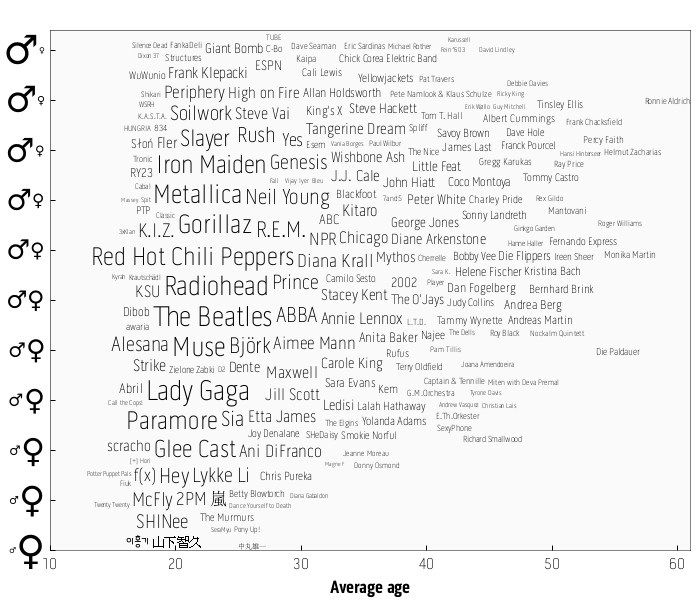
One thing no one would find surprising is how certain styles of music -- and some highly acclaimed artists -- broke down across gender lines. According to my very unscientific data, men generally don't listen to female artists much, and last.fm agrees. I thought this proclamation from their blog was disappointing -- but not at all shocking:
"So, you can now use this plot to decide which music you might want to listen to. For example, if you are a healthy young male in your early twenties, you probably should listen to bands such as Iron Maiden and Metallica. Gorillaz and Radiohead might just be acceptable. If you get older you can then switch to artists like Neil Young and Genesis. It’s all quite obvious really."
Wednesday, August 25, 2010
Musical Dealbreakers
There was an interesting discussion over at Jezebel this week about "musical dealbreakers." You know, those bands or artists that could possibly ruin a potential relationship? I don't know if it's age or that I'm not the music geek I thought I was, but I really don't have any. Given that I listen to Cher completely sans irony, and have had fleeting obsessions with oddball artists like Klaus Nomi, maybe I'm not the one to decide the dealbreakers.
Here's something else that rarely gets mentioned when the topic turns to music: who gets to decide what's canonical or sacred. Musical "taste" is something that can't really be pinned down, though I know plenty of inveterate music geeks who's dealbreaker would be the trifecta of Bruce, Neil and Dylan. If you can't like those three, or at least acknowledge their influence, you cannot have "taste." It took me almost two decades to decide that, no, I really don't like this Dylan person, and that's okay.
In the grand scheme of things, the songs on your iPod are of little importance, but when you've spent the better part of your adolescence and early adulthood with a definite idea of what "good" is -- be it music, books, movies, whatever -- it's only when you start questioning who gets to decide what's worthy, what makes it into the "big book of rock," and what's relegated to footnote status, you understand how many artists have been excluded.
Saturday, August 21, 2010
A Heads Up For Those Of Us Not So Musically Inclined
This probably comes as a shock to no one, but I know very little about the mechanics of making music. I know what sounds good to my ears, but rarely do I have the vocabulary to tell you way.
This shouldn't be an issue, really, when the most I'm doing is talking about how music relates to popular culture and to the world at large, but every little bit of knowledge helps. Pandora's Podcast Series has been a huge help.
(Disclaimer: I do not work for Pandora, nor am I getting paid to promote their podcasts. It's just that Pandora is has been a great resource for discovering new music -- or rediscovering old music -- and these podcasts have been a godsend for the musically challenged.)
One thing I really like about this series is whether the topic is recording vocals, time signatures, or composition, they always give good, concrete examples -- usually in the form of very familiar rock, pop or indie songs.
Thursday, April 15, 2010
Lady GaGa: We Chose Her
Rachel Rosenfelt and Jennifer R. Bernstein from PopMatters wrote an incredibly detailed analysis of Lady Gaga's fame, calling her "he first democratically elected pop star."
"Web 2.0 has dissipated any paranoia that the sales-driven music industry might exert total control over mass culture—and although market forces retain their power in cyberspace, we have gained greater independence and flexibility in consumption than we have ever known. The radical increase in consumer agency licenses even the most skeptical highbrows among us to take pleasure in Gaga’s audiovisual spectacle. She has not been chosen for us; rather, we have chosen her."
Of course, you could argue that pop stars have always been chosen by us -- by the records we buy and the concerts we chose to see (as some of the commenters have pointed out). It's only the tools that are different.
Subscribe to:
Posts (Atom)