Showing posts with label dudes and dude rock. Show all posts

Tuesday, August 16, 2011

Rewind: The Replacements - Tim


He had me at "down on all fives... Lemme crawwwwwl!"

There aren't many records that from the first listen caused me to have a bona fide visceral reaction. I wish I could say the album that made me a music fan was Liz Phair's Exile in Guyville, or Tori Amos or anything else that seemed to resonate with a lot of women born in the 70s and 80s. The Replacements' Tim is, for better or worse, my "it" record though, the kind of record that Sleater-Kinney's Carrie Brownstein said :will stop you dead in your tracks beacuse now, whatever path you were on no longer exists." I actually kind of recoiled when I first played it. This band can't play, I thought, and he surely can't sing, but it was so perfect. They were smart without being painfully intellectual, raw and nervy, but still fun. I wanted to break stuff and dance. Until then I'd been somewhat of a punk rock dilettante: The Ramones were goofy, and the Clash was smart and irreverent, but I was only a casual fan. And they were relics of another generation. I didn't yet know there was a crop of younger bands in garages and basements across America, pounding out their own version of rock 'n' roll. If it wasn't handed down from the gods at MTV or coming from the speakers on my shitty $40 boombox, it didn't exist in my world. Tim was the record I'd been looking for my whole life, and I didn't even know it.
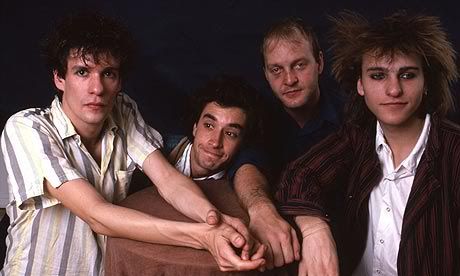
Long before the internet became the great equalizer, the only way I'd hear about bands that didn't get much airplay was through the pages of magazines like Musician, Creem, or Spin. I had been reading about this mythic beast known as the Replacements for years. They were four working class kids from Minneapolis who had a taste of success with "I'll Be You," a song from their second to last album, Don't Tell a Soul. I'd heard the song on a local AOR station, probably sandwiched between Warrant and Lynyrd Skynrd. I wasn't that impressed.

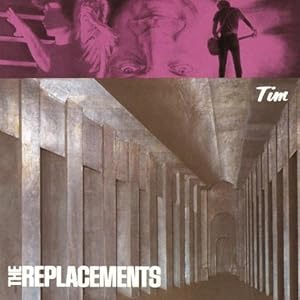
I let a few more years pass. I was in my twenties then, out of college, and looking to expand my record collection. I was thumbing through the used cd bin at a used record store when I spotted what was probably one of the ugliest album covers ever: all purples and grays with a picture of a long corridor or tunnel on the front and the title, Tim, written in yellow cursive in the upper right corner underneath what I think were rough pencil sketches of each band member. I'd read enough reviews to know that it was part of the "holy trinity" of Replacements albums. (1984's Let It Be, brazenly named after the Beatles album, and Pleased To Meet Me, which came out in 1987, were the other two.) I had five dollars burning a hole in my pocket, the exact price.

I didn't play that it right away. When I got home I set it down on my messy desk where it stared at me for a few days. I don't really know when it hit me that this was going to be the turning point in my musical education, but I had to get past my idea of what good music is. I was raised on top forty pap, and this was anything but. There was nothing polished about it. It sounded like the type of music my guy friends in ad-hoc garage bands made. Because it kind of was.

I rarely listen to Tim anymore --  to be honest, it hasn't aged well, though I blame the production more than anything -- but I definitely consider it my gateway drug to more ambitious records.

Tuesday, July 12, 2011

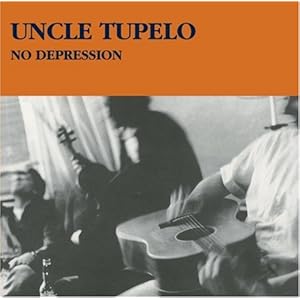
Rewind: Uncle Tupelo - No Depression

There's been a rash of nostalgia Clinton-era pop culture, and a lot penned by women describing how it changed their lives for the better, but my fondest memories from the 90s didn't lead to any kind of a feminist awakening. I'm not sure if I'm supposed to be ashamed of this or not. But no matter how often I'm tempted to rewrite my own history (subtract a Westerberg here, add a Liz Phair there), I can't really deny that the 90s was when I discovered a lot of great music that was just that -- great music -- and it wasn't necessarily tethered to my personal politics.

I write a lot about being a fan, and being a feminist, and how to unite the two. In theory I do this well; in practice, well, I tend to go with what sounds good to my ears.


(I can't write about Uncle Tupelo without first mentioning Mississippi Nights. One thing I always loved about that place was how accessible the performer was to the audience. A lot of nights, the band could be seen mulling around in the crowd while the opener was on stage. Though it was never really what you’d call a small club, the atmosphere was undeniably dive-like in the best possible way.)

I always think of No Depression as county music for people too cool for country. Let's face it, country music is incredibly polarizing and comes with some pretty hefty baggage. It's the soundtrack to conservative America. And while I'm loathe to admit it, it's also the soundtrack to my early childhood. Uncle Tupelo was as close as my city ever got to having a hometown band and, consequently, a "scene."Yeah, technically, they’re from Belleville, but at the time, Uncle Tupelo were our “local boys made good,” if not on a commercial level, then on a critical one. And on a sentimental one.

Tuesday, April 5, 2011

Music Diary Project, Day One: Leap of Faith, Or a Jump of Stupid

(Note: this is my first post for the "Music Diary Project." I did this a little differently than I probably will the rest of the week, which most likely will be more a "log" of all the music I actively listened to for the day, not counting music overheard in stores or in movies or on tv. I did this on purpose because I usually feature a single album on Tuesday, and I really wanted to listen to this particular record in its entirety again.)

It's rare that I play albums in their entirety these days unless I'm writing about them, and it's even rarer that I go back and listen to an album in its entirety after abandoning it several years earlier. I am a chronic "shuffler." And from my twenty-plus years as a music fan, I've learned you can't force a "Proustian moment." More often than not, the magic the magic is tethered to that first listen.

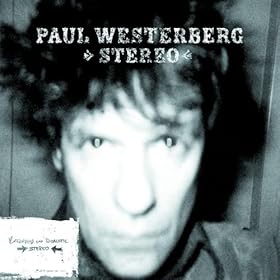
I made an exception with Paul Westeberg's Stereo and 49:00. Two albums that, I think, that bookend his "basement tapes" era. When I first listened to Stereo, damn, eight years ago, I thought it was desperately sad, but hopeful -- like the beginning of something. And for him it probably was: freed from his label, producing and (allegedly) playing all the instruments himself. The Replacements are the only band I've managed to become unhealthily obsessed with*, and I went in with zero expectations. The solo projects that come after a band's breakup are usually held in contempt by its most inveterate fans. His first three were good, but nothing earth-shattering.

The verdict after nearly a decade? One of the things I loved about Stereo was its ability to read, not like a record, but a series of vignettes or a book of short stories. It still does that, but it's the same story of middle-aged, suburban, white guy angst throughout the dozen or so songs. Granted, he's very good at white guy angst.

49:00 is a different beast altogether. 49:00 released as a single track a few years ago (for the bargain price of $0.49), it's a jumbled mess. I still haven't warmed up to it. There's a lot of good -- maybe even some brilliance -- but my linear brain hates to pick through the mash of songs to find it. The one thing I find interesting is that, buried in the unholy mess, is Paul at his most vulnerable. He said in an interview with Musician magazines decades ago that he often creates characters to allow himself that vulnerability, but here he's almost dangerously close to his own lyrics. Aren't songwriters supposed to be close to their material? Not always, and it's probably healthy to have some fiction involved. I wonder if releasing it in the limited format without a lot of attention allowed him to get that close.

*I even have a goofy fangirl shot of me with Paul. I sincerely remember throwing my arm around him and thinking, "His shoulders feel stronger than I would have expected." I thought he'd be sort of frail, ready to crumble at the slightest poke. (Like Beatlejuice of maybe Keith Richards.) But the picture I have shows my arm hovering awkwardly above his shoulder, and he with a bemused expression on his face.

Thursday, September 23, 2010

Last.fm Tells You What You Should Be Listening To (According to Age and Gender)

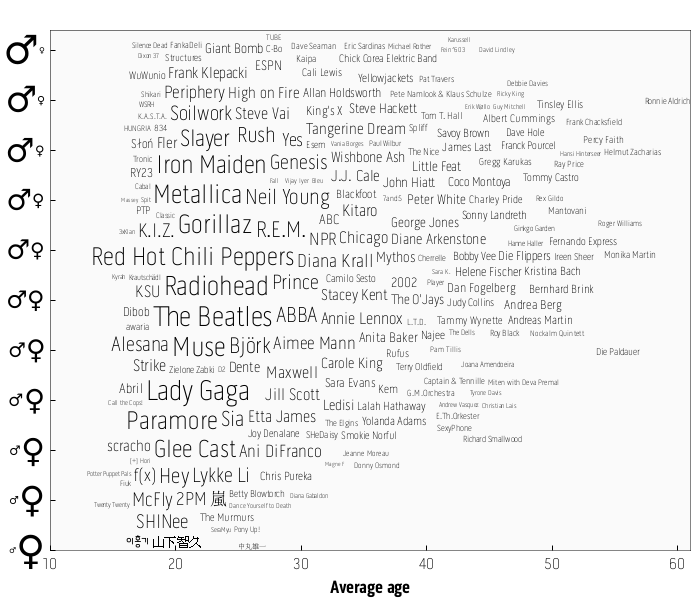
The nerd in me loves this sort of thing, but the amateur Judith Bulter in me says, "OH RLY?" Last.fm just launched an app that graphs the average age and gender of your top artists listeners, and you can how you measure up. I am apparently in my mid-twenties, almost decade off, but very much a "girl" in my musical taste:


These kinds of tools are fun and shouldn't be taken too seriously (no one can tell you what you should be listening to), but I do have a few questions, namely what is the average age of a last.fm user in general? I'm guessing the results skew sort of young because (from what I can tell from using the site for the past four years) last.fm users tend to be in their twenties. I popped some of my friends' names in, most of whom are in their thirties and forties, and all of them had the musical taste of someone much younger, according to last.fm's data. And the site overall is rather "indie heavy." It seems that certain types of music fans use last.fm. The site's own particular demographic should be taken into consideration. (You can look at last.fm's users' most listened to artists by age and gender here. )

One thing no one would find surprising is how certain styles of music -- and some highly acclaimed artists -- broke down across gender lines.  According to my very unscientific data, men generally don't listen to female artists much, and last.fm agrees. I thought this proclamation from their blog was disappointing -- but not at all shocking:

"So, you can now use this plot to decide which music you might want to listen to. For example, if you are a healthy young male in your early twenties, you probably should listen to bands such as Iron Maiden and Metallica. Gorillaz and Radiohead might just be acceptable. If you get older you can then switch to artists like Neil Young and Genesis. It’s all quite obvious really."