Showing posts with label documentary. Show all posts

Thursday, August 25, 2011

The Year Punk Came to DVD

Technically, punk never broke in 1991. Yeah, that makes me sound like some sort of rockist snob like Jack Black's character in High Fidelity, but I've always found the title of the documentary, 1991: The Year Punk Broke, curious. Looking back at the early 90s -- which is something I'm loathe, but compelled to do -- they weren't very punk unless you had access to a network of zines, mom-and-pop record stores, or college radio. For most of us, the underground was just that -- underground. I was well into my twenties before I'd heard of Sonic Youth, the subject of this doc which will finally be released on DVD in the next few weeks. Lots of 90s alt-rock stars abound, including Nirvana (who was "breaking" at the time), Babes in Toyland, and Dinosaur Jr.

I was only on the periphery of the 90s punk scene, grabbing little snippets on the lone, low-powered community radio station before the big RAWK! one picked up Nirvana and Pearl Jam (the latter I have no doubt would have fit with their playlist had grunge never happened), or weirdly enough, though the pages of fashion magazines peddling flannel and ennui as a fashion statement. It's easy to forget in the days before youtube, Facebook, and multi-tiered cable how hard it was to find music that fell outside the top forty, a term that's now become obsolete -- and meaningless.

Saturday, August 20, 2011

Gloria: In Her Own Words (And Ours)

tumblr 
HBO's documentary on feminist icon Gloria Steinem, Gloria: In Her Own Words , is a fine "primer," so to speak, of the activist and the movement she has become the face of, but leaves out the very important issues of race, class, and sexuality that plagued second-wave feminism, and continue today. Andrea Plaid from Racialicious:
The reason why I called this doc “precise” is because I didn’t expect it to be nothing more and nothing less than a reflection of the mainstream Second Wave feminist movement…which was, in reality, notoriously short on analysis of race and racism as it functioned within it. When it was addressed, the rhetoric talked about white men and their race vis-à-vis “male privilege.” Some of the white women within that movement may have deeply empathized with and felt themselves in solidarity with the struggles of people of color—Steinem presents herself as such a person—but, as cravenly cynical as it seems, those struggles were also a media-friendly “hook” so people could grasp why women were fighting for, say, equal pay and the right to safe abortion. And, as critiqued again and again, loaded with white female privilege.
Maybe I'm being unusually optimistic, but I had hoped the second-wave's lack of women of color, working-class women, and sometimes outright disdain for queer women would have been addressed, but befitting a mainstream documentary, it was only briefly given lip service. It's too bad, because those problems still plague feminism today. Granted, this was more a personal look at Steinem herself, and in that, the film excelled, but being that her identity is intrinsically tied to the second-wave feminist movement, I expected more.

Sunday, May 8, 2011

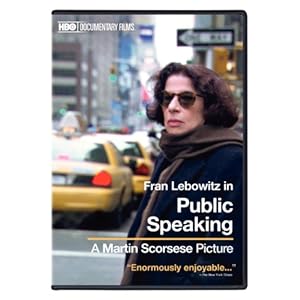
Fran Lebowitz: Public Speaking

It actually premiered on HBO back in November, but Martin Scorsese's Fam Lebowitz documentary, Public Speaking, is currently available On-Demand and will be released on DVD May 24th:
[...] Indeed, as Lebowitz says in one interview among the many here, she is first and foremost a public speaker, a woman who takes talking to a high art form after she dreamed, as a child, that people would care about her opinions. Public Speaking chronicles a truly iconoclastic author and thinker whose satirically barbed wit is hilarious and controversial on the page, as well as onscreen. In her interviews she pontificates most vocally about her experiences as a New Yorker, as a writer, journalist, feminist, smoker (yes, she actually takes the protection of cigarette smoking rights up as a cause), and gay rights activist. What it adds up to, in her words, is a devotion to maintaining individual freedom. Most poignant, however, are the scenes in which she places herself historically within a New York cultural framework, as she remembers first writing for Andy Warhol's Interview magazine, then publishing her first hit novel, Metropolitan Life.  - Trinie Dalton
Full disclosure: I've been a fan of Fran Leobowitz since I first picked a copy of The Fran Leobowitz Reader when I was in my early twenties, so it's not exactly possible for me to offer an unbiased review. Listening to her talk, though, is the best way to experience Fran Lebowitz, which is why this documentary is so effective.

Wednesday, March 30, 2011

Miss Representation

Jennifer Siebel Newsom's documentary, Miss Representation is "an inside look" at the messages the media sends to and about women:
As one of the most persuasive and pervasive forces in our culture, media is educating yet another generation that a woman’s primary value lay in her youth, beauty and sexuality—not in her capacity as a leader, making it difficult for women to obtain leadership positions and for the average girl to feel confident herself. Stories from teenage girls and provocative interviews with politicians, journalists, academics, and activists like Condoleezza Rice, Lisa Ling, Nancy Pelosi, Katie Couric, Rachel Maddow, Rosario Dawson, Jackson Katz, Jean Kilbourne, and Gloria Steinem build momentum as Miss Representation accumulates startling facts and statistics that will leave audiences shaken and armed with a new perspective.


A list of screenings can be found here. (It should be showing on Oprah Winfrey's OWN network in the fall.) This looks incredibly promising, but as Dodai from Jezebel states, Miss Representation "may be preaching to the choir for those of us already frustrated with sexist advertising and misogynistic media."

Tuesday, March 29, 2011

Rewind: Shut Up and Sing

courtesy of last.fm
I'm not the biggest supporter of mainstream country. It's not the music or the artists, which I don't consider all that different from other genres of popular music, but country music has huge image problems. It's pretty hard to disassociate the sound with the stereotype: country music fans are evangelical jingoists with truck nuts and confederate flags hanging over their garage doors. Country music's image as the soundtrack of the extreme right makes it hard for me to now embrace a style of music I grew up listening to. And the times that trope plays out to be true, well, it's kind of hard to argue why country gets a bad rap.

In 2003, the Dixie Chicks were one of the top selling acts in mainstream country. When frontwoman Natalie Maines said on a British stage that the Dixie Chicks were "ashamed the President of the United States is from Texas," it caused a whirlwind of controversy in the mostly conservative country music world. The documentary, Shut Up and Sing, was released three years later, and tells the story of what happened then, and later as the Chicks tried to rebuild their career and move toward a more adult-contemporary sound.

I remember when this happened, and hadn't thought much about it in the intervening years. As someone who listens to a number of artists who thrive on controversy and being politically outspoken, I thought the whole thing was ludicrous. I didn't know about the threats, the banning, and the outright vitriol of the country music-listening public. That, sadly, doesn't surprise me, but I think it's important to look at the way women in the industry are treated when they make remarks deemed "controversial". It was hateful, mean, and downright sexist. They were called "twits,""dixie sluts," and "bimbos". I really recommend watching this, even if you aren't a country fan. As it stands, what happened to the Dixie Chicks is a pretty good example of the kind of misogyny that permeates popular music. God forbid you are woman with a thought in her head that wasn't put there by her handlers. I came away with a lot of respect for the Dixie Chicks, as artists and people.

Sunday, September 12, 2010

My Mic Sounds Nice: A Truth About Women in Hip Hop

Read Latoya Peterson's review of My Mic Sounds Nice, a documentary on women, sexism and hip hop, which aired on BET recently. She talks a little about the 90s and how during that decade women started making inroads in the world of hip hop, but also had to sex up their image to gain acceptance:

"Lady of Rage talked about feeling pressured in as time went on to soften her look, to lose weight, to become more visually appealing, and all the female emcees echoed similar sentiments. They showed images of Da Brat at her debut and in the 1990s, noting that most women felt obligated to trade in their jeans, caps, and Tims for a more stereotypically feminine look."

Watch My Mic Sounds Nice here.

Monday, June 14, 2010

Le Tigre: On Tour

(Via AfterEllen  and Bitch )

Le Tigre: On Tour is a documentary/concert film shot during the bands 2004-2005 tour. Says AfterEllen :

"Beginning with a random home rocket kit test flight, Le Tigre: On Tour takes an irreverent look at the camaraderie and adventures of the team, and spends a lot of time fawning over the most masculine of the trio, JD Samson. Dykes will appreciate the attention paid to this mustachioed butch dreamboat who comes across as genuine, humble and sexy, even when she's accepting champagne from adoring fans."

Bitch Magazine also posted a short review:

"The documentary references their battles waged in the name of gender display, remaining both feminist AND lesbian in their politics even when media coverage is on the line, and those that centre on an all too familiar theme in feminist work – a sharpened outsider focus on women’s relationships and connections to the ‘larger than life’ works of men (in Le Tigre’s case, it’s Hanna’s cleverly writing ‘Kurt smells like teen spirit’ on Cobain’s wall one evening causing the anthemic song to be written, but we needn’t look far to see this trend continue on in popular culture. The buzz surrounding Kathryn Bigelow, even from a feminist lens, more often than not, whispers the name of James Cameron too)."

I missed much of the riot grrrl phenomenon of the 90s and early 00s, I'm anxious to see this. Unfortunately, there are only a few screenings listed.