Cazz Blaze wrote a great post for the F-Word about the perceived lack of "angry young women" in genres other than rock or punk. She says:
[...] there is the basic assumption that angry women only exist, music wise, in the area of rock music - we presumably don't have angry pop stars because there is a credibility issue that goes with being mainstream and angry (ie people would assume you aren't really meaning it, see Alanis Morrisette as a case in point) but also people don't talk of angry dance music, angry urban music, angry folk music... Why is that? Why must anger be equated with an electric guitar?
As much as riot grrrl brought feminism and the inequality of being a woman in society to the forefront, this is one of my biggest pet peeves, too: its claim to the anger and righteousness that comes with that awareness, almost exclusive to other styles of music. Riot grrrl suffered from its own internalized misogyny, pitting pop against punk -- good girl (quite, complacent, well-behaved) against bad girl (outspoken, polemic.)
One of my favorite "angry woman" songs of the last half-decade or so is Martha Wainwright's "Bloody Mother Fucking Asshole." Along with the examples provided in the original post, there are quite a few angry folk (or folk-rock) songs penned by women. Hip-Hop has produced its share of stealthily feminist righteous anger also:
Read Latoya's post on Nirvana, riot grrrl and race for Racialcious. She explores a lot of what I think is wrong with the current deluge of 90s nostalgia.
This is part of the quote posted to Jezebel (from a CNN article) that spawned a pretty interesting discussion about pop music, privilege, and why today's performers pale in comparison to the artists of yesteryear (read: the 90s).
If you're inclined to believe such things.
I mean, is it really that different when it's a skinny white woman in a bathing suit singing these things? None of these women ever wear pants, first of all. Second of all, just because you're wearing a goofy hat doesn't make it performance art. I mean, that's just my feeling about it. — Kathleen Hanna (Source)
Let's break this down. On the surface, this looks like a clear case of artist vs pop star (we've been through this before ), but Kathleen Hanna herself is a skinny white woman — quite a bit of privilege there. That's where the hypocrisy lies, not in her criticizing other performers, or even other women. This comment nicely sums it up:
But it seems to me that Hanna benefits from the same things that she's criticizing Ke$ha, Perry, and Gaga for. She's thin, white, and pretty, and from what I remember, wasn't that fond of pants in her heyday either. Riot grrl seems to have relied very heavily on shock value (like throwing a tampon into a crowd, which I realize was unusual, but it sure seemed iconic), which is just one way to get a message across. Sexuality was a huge part of how messages were transmitted, and while there was a critical eye as to the heteronormativity of the messages, it wasn't always successful at subverting the standards it claimed to. (Jezebel Commenter boxpelunker)
There's an unspoken tenet in feminism that says it's wrong to criticize other women. When it comes to performers, especially, what you're really criticizing is their product or their public persona. I think this is completely within the realm of acceptable, and even healthy, particularly when those artists rise to the level of "iconic.". But it's also healthy to remember who controls what's accepted into the canon and what's not. Without rehashing what I've already written, look at any critic's best-of list: it's always almost exclusively white, male songwriters. I cringe when I hear someone my age, particularly someone who maybe played with some of the same tropes, criticizing today's pop stars as less than substantial. Not because I think they are, but because I think the chasm between good (punk and indie) and bad (pop) isn't as wide as people want to believe. I think about this every time I sit down to write something about the trifecta of Ke$sha, Katy Perry, and Lady GaGa. The three of them inspire as much hated as they do adoration. I don't listen to their music, but I've refrained from criticizing them for those reasons.
From the now seven-year-old edition edition of Sisterhood is Forever. I'd never read this anthology before Actually, I had my reservations, as I thought it was a lot of the same voices, which is kind of a problem in feminist circles. It turns out there are some really great essays in it, including these salient points from Katheen Hanna on riot grrrl's early days:
The riot grrrl movement I knew in the 90s wasn't ever really the cohesive political movement many reporters claimed it to be. It was more like a music scene, one that used politics to shape itself. It created feminist songs and 'zines, benefit concerts and parties; it raised consciousness. But it didn't formulate policy, or even protest much outside the parameters of underground music. This led to a self-referential insularity that often confused personality conflicts and petty intrigues with serious dialogues about race, class, and power dynamics as they played out in our collective activities.
This is a big part of why riot grrrl never appealed to me. The things that came to define third-wave feminism -- punk rock, 'zine making -- weren't available to all girls, so a lot of people were shut out.
I writea lot about riot grrrl's insularity and inaccessibility, but offer few solutions. Solutions are kind of moot for a movement forever rooted in 90s culture.
I guess what I'm saying is stop romanticizing it.
This is what I wrote on my Tumblr yesterday when I was trying to work out this post. I know I'm becoming a little one-note, but I think this is important:
Unlike a lot of women my age, riot grrrl wasn’t my avenue into feminism. I’ve always felt a little silly even writing the words, “riot grrrl.” I had no idea what RG was until long after the fact, and the media had reduced it to a sartorial statement.
Ergo, it isn’t mine to write about.
But it is because I never felt that riot grrrl was something for me: a working-class kid, living in a conservative part of the country and not attending a liberal college. Riot grrrl was insular, not accessible to everyone, and fell victim to some of the same problems of second-wave feminism. Everything I know about RG is decidedly unromantic. But for generation of women, now in their twenties and thirties, criticism of riot grrrl is anathema.
I understand wanting to curate something that meant the world to many girls who felt that feminism was something antiquated, but for a lot us, riot grrrl was just as exclusive as our mothers' feminism, which has taken a fair amount of heat (and rightfully so) for addressing the needs of only straight, white, cis, middle-class women. We can do better than that.
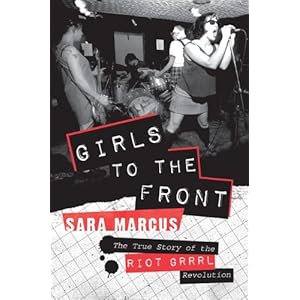
So I finally got my hands on a copy of Sara Marcus's Girls to the Front and haven't put it down for the past two days. I think I'm really starting to understand the "scene" aspect of riot grrrl, or, rather, the lack of a unified scene, which made it difficult to define riot grrrl despite mainstream media's best (or worst) efforts. Going by the handful of magazine articles written in the early nineties, one would think riot grrrl was nothing but babydoll dresses and smeared lipstick punks with just a side order of feminist politics. Reduced to its sartorial effects, the movement loses its power. And girls stuck in the middle of the country or away from a major city got their information piecemeal: a short article here, maybe a some airplay on a low-power college station there. I was one of those girls, and everything I knew about riot grrrl came from traditional media. The way it was presented in the mainstream press, I just assumed I wasn't cool or smart enough for it. Plus, I was never much of a fan of punk rock, and it was impossible to disassociate riot grrrl from its music.
It's kind of a sad fact that, especially in the pre-internet age, riot grrrl needed the mainstream to reach all those girls grasping for feminist role models, but it was the mainstream that ultimately sold them out. In that respect, I like that that Girls to the Front was told from the inside out. It answered a lot of questions I had, and I don't feel as much resentment towards it now. It was about the music, but much more. And I'm kind of surprised that riot grrrl's heyday lasted only a few short years -- at least in the big history of rock -- but as cliched as it sounds, its impact is still felt today.
Random tidbits from the notes I took while reading:
Fugazi's influence as a political punk band fighting against the sexism that is part and parcel to hardcore: noted. Their song, "Suggestion" is sung from the point of view of a woman being harassed, and lauded as an anti-sexist anthem. It always smacked of appropriation to me. I couldn't help but feel validated when I read this:
"'Suggestion' was still Fugazi's song, though, and in recent months it bad begun to sound to some riot grrrls like a self-righteous white boy appropriating girls' issues so he could appear more virtuous."
I never doubted Fugazi's motivations, I just thought it was a bit misguided. That they let women come up on stage and sing lead presents it in a different light, though.
On riot grrrl's mostly white, middle-class majority:
"Some of the riot grrrls knew their group wasn't perfect. They were good at talking about what they had in common, but they weren't sure how to approach their differences. For instance, while a majority of the people involved were white and middle-class, quite a few were Latina, black and Asian. And some had grown up in struggling families. These things were rarely discussed."
This has been my primary criticism of riot grrrl, and I see parallels in the feminist blogosphere today. Although some of those walls have broken down, it's an ongoing process to fight against the biases and privilege.
Overall, I really enjoyed the book have a lot of respect for the women who were part of the early days of riot grrrl. I especially liked that riot grrrl's story wasn't sugar coated, but presented as something as complex and, at times, as flawed its members.
As glad as I am to see another book written about third-wave feminism and 90s riot grrrl culture, I wonder where are all the women, children of the 80s and 90s, who came to feminism late, or through other means. (Me? A library card and my two feet, oblivious to a groundswell of female-fronted punk bands.) I know I've been critical of the riot grrrl movement in the past, but Sara Marcus's Girls to the Front looks like a good read, and I hope it addresses the problems of riot grrrl (the cliquishness, the exclusiveness, etc.), along with its successes. From Publisher's Weekly:
"A Brooklyn-based journalist gives a brash, gutsy chronicle of the empowering music and feminist movement of the early 1990s led by young women rock groups like Bikini Kill and Bratmobile. Politicized by such national events as the backlash against feminism in the press, the first Iraq War, and the Supreme Court's gearing up to review Roe v. Wade, young women were incensed."
Johanna Fateman from bookforum described the atmosphere of those early riot grrrl days well in an early review for the book, and I can't help but feel a little cheated:
"Any stab at defining Riot Grrrl still feels dangerous. In its self-mythologizing rhetoric, the revolution belonged to all girls but couldn't be owned or represented by any one. Its work was done in secret, in incremental and internal acts of resistance, as well as publicly through songs, zines, gatherings, and, as a 1992 tour flyer for the bands Bratmobile and Heavens to Betsy announced, "new aesthetics and ways of being." Now, Riot Grrrl struggles to be heard over almost two decades of associations—its influence detected in the emancipatory vibe of female-fronted tween pop and the periodic ascent of a woman rock star. But in the original anthems of Riot Grrrl, "Girl Power" was not the can-do sound track of gymnastic routines. It was the power to confront a rapist, an urgent challenge to the systematic silencing of girls, and the invocation of inconsolable, vengeful, and exhilarated revolutionary states, which would have been as unwelcome in Spice World as they were in The Man's world."
I could have so gotten behind a movement that defined feminism for someone my age, but as a working-class, Midwestern girl in the early 90s, feminism was still an unfashionable relic of my mother's generation: something served with a side order of organic lentils and worn with sandals. I grudgingly identified as one even though I knew no others. I could have used a dose of loud, raw rock with my political awareness. I'm definitely reading this book.
Before I started this blog, I read a glut of books on rock history or rock criticism, mostly those written from a feminist angle. One of the books I picked up was Maria Raha's Cinderella's Big Score, which focuses on women in the punk and indie scene from the 70s through the 2000s. Instead of writing a review of my own, I'll just point you to Alyx's, which is much better than anything I could write anyway. This especially rang true:
"Raha is very much of the “indie rock, good; pop, bad” persuasion and does little to challenge her biases or problematize the book’s subjects. As many of the rock artists she holds in high esteem are white women and many of the pop artists she dislikes are women of color, this creates an unintentional yet unfortunate gendered racial tension.
I think about this a lot. When I co-teach music history workshops with Kristen at Act Your Age, we notice that the reception of certain musical subgenres is divided along racial lines. Participants of color tend to get excited about hip hop, R&B, and pop and check out during discussions of punk and riot grrrl. It might be that riot grrrl means a great deal to white girls and white women, but doesn’t speak to many girls and women of color.
(Note: This isn’t to say girls and women of color can’t relate to or be inspired by riot grrrl; I just wonder how many do.)"
I think this says a lot about the recent deluge of 90s "girl-culture" books and blogs focusing on riot grrrl and indie culture (see below). It almost actively shut people out (through the media blackout and the general cliquishness), and that was a huge turn-off.
I do want to add that one thing Cinderella's Big Score did well was include a handful of queer bands that probably wouldn't make it into the great book of rock.
(Update - I did this a few nights ago and after much deliberation, deleted most of what I'd written because it sounded overly critical of the whole "riot grrrl" scene of the 90s. I'm in a weird place: on one hand I love a lot of that music and "get it." On another, I see the classism and elitism of a scene that makes itself largely unavailable to girls who need feminist role models. Also, as I was writing that last sentence about not have my "sense of self stripped away and replaced by something new," I realized it wasn't my scene, and trying to write about it as if it was feels forced and unnatural. Truth be told, I was a a little too old for riot grrrl or even for Tori, Liz or Alanis. Maybe had I still been in high school, I would have has that "woo-hoo!" moment. I probably needed them in high school.)
Sometimes I feel as if I'm rewriting my own history.
There's been a spate of books and blog posts written about 90s female-led rock bands, and though I listened to a lot -- a lot -- of that music throughout my late teens and early twenties, I always felt I was hovering on the periphery of that scene. I love reading other women's accounts of Liz Phair or Alanis or Bikini Kill changing their lives, but I'd be a hypocrite if I said that every record I ever loved was somehow life-changing. Some of them were just records I loved. Music didn't teach me how to be a strong, outspoken critic of the patriarchy. I had a library card and an equally outspoken, second-wave feminist mother for that.
I had a simple system for discovering new music: I turned on the one good radio station whose idea of alternative wasn't a continuous loop of Stone Temple Pilots, Pearl Jam, and Jane's Addiction. Or I went to one of my city's few enclaves of hip and glommed onto whatever didn't look or sound like anything on MTV. I actually think I was pretty lucky.
Sleater-Kinney's Dig Me Outwas one of those albums I picked up sometime in the mid-nineties. I didn't have any great epiphany during that first listen. No "a-ha!" moment, just a subtle sense of recognition: here were three women who were my age, dressed like me, and sang about all the bullshit banging around in my head. Oh yeah, and they could play their asses off.
But none of it felt new to me. I mean, I was already there. The artists who stripped away my sense of who I was and replaced it with something better came before all that - Patti Smith, Laurie Anderson, Grace Jones, Siouxsie Sioux, and X's Exene Cervenka. The template was already in place. It just needed a bit of an update.
I feel like a relic of another generation where women with ripped stockings snarled lyrics into microphones and smashed guitars. Rage against the patriarchy! Where did they go? Were all of them replaced by either nice girls singing about high school crushes, or skimpily-clad vixens? Jude Rogers for the Guardian asks the same question: Are there any angry women left in rock?
"...women in rock are rarely angry any more. It wasn't always this way. After the Runaways, a rush of punk performers – including Siouxsie Sioux and X-Ray Spex's Poly Styrene (who mocked people who thought "little girls should be seen and not heard") – and then later the riot grrrl groups of the early 1990s showcased women who offered empowering messages as they pummelled their guitar strings. Twenty years later, the charts are full of female musicians, so maybe their predecessors genuinely opened doors, and also broke down prejudices. But look behind the charts. Look, say, to the media. Look at Q magazine, for example, which still treats "women in rock" as a genre all of its own, and only featured three women on its cover in the last year, all in states of undress (Lady Gaga, Cheryl Cole and Lily Allen). Have women yet been accepted in rock music on their own terms?
You could argue that there will always be room at the top for those artists willing to "sex up their image," and that the raw, angry punk of the 70s, and later the riot grrrl bands of the 90s weren't exactly selling out arenas, but there was a small window of acceptance -- or at least curiosity -- especially in the early 90s with mainstream magazines featuring bands like Hole and Liz Phair. (Both sold a fair amount of records, I recall.) The charts may be littered with female artists, but at what price?