
Showing posts with label lucinda williams. Show all posts
Showing posts with label lucinda williams. Show all posts
Monday, April 22, 2013
Earworm of the Day: Lucinda Williams - Unsuffer Me
I grew up with country music. I can't, in good faith, listen to much of it anymore. Country music -- mainstream, country music -- carries too much baggage, is too tied to a particular ideology, but Lucinda Williams has been the one constant in my life. Well, the one constant in my musical life.

Sunday, July 29, 2012
Five singers who subvert the "prettiness imperative"
I've been reconnecting with the music of my misspent youth. And as someone whose musical musical diet relied on healthy servings of punk and indie rock, that means lots of white boys and guitars. Of all the genres and sub-genres of popular music, rock and all its permutations has been the least able to achieve some sort of parity, and, not so surprisingly, still maintains a sense of credibility among critics, It's plainly obvious whose music is considered art, while whose is considered commerce.
This week it's been Wilco's Yankee Hotel Foxtrot I've had on repeat. I've long been a fan of Wilco -- Jeff Tweedy is from just outside my city, so he's always had that "hometown hero" appeal, even though he rarely plays and lives in the windy city now. At just over a decade old, it may not be cool anymore, and singing its praises now more than marks me as an aging rock fan, but YHF is one of the most intriguing records to come out of the 00s. and I've been paying a lot of attention to Tweedy's voice. While I've never really been a fan of his singing, which stylistically wavers from a Dylan-inspired twang to a hoarse Jerry Garcia, his broken rasp fits perfectly with the music. I wondered, what would happen if a female artist sang that way?
I keep going back to this Tiger Beatdown piece from a few years ago, but it flawlessly illustrates the "prettiness imperative" that female artists face. To make good music, one must be willing to takes risks -- to sound "ugly," but not at the cost of the inherent sexiness that sells records.
"Because for women, prettiness reigns. Being pretty, sexy, fuckable, is of paramount importance. This extends not only to appearance but to action. Which is where rock ‘n roll comes in. Because in order to make good rock music, you have to be able to do things that are not pretty. Pretty is not interesting, pretty is not groundbreaking (unless it’s juxtaposed with things that are not pretty), pretty is boring. And pretty is the thing that our culture enforces on women with a vengeance. The prettiness problem excludes women from rock ‘n roll in a three-phase process."Earlier this year I wrote about Merrill Garbus, whose album whokill was topping every critic's best-of for 2011. While she garnered tons of critical acclaim, some pop culture pundits were flummoxed, notably Chuck Klosterman. Her vocals are noticeably un-pretty by conventional standards. Granted there have been, and are, many artists who don't rely on sex appeal, but their voices still fell into what's considered acceptable for a "girl singer." I tried to come up with a few more examples of female singers who aren't afraid to make an "ugly" sound.
Tuesday, February 28, 2012
Break It Down: Passionate Kisses
I first heard Lucinda Williams's "Passionate Kisses" via the Mary Chapin Carpenter cover that was all over the radio my first year in college. A few years later, I sought out the original version, but I still like to maintain that during the 90s when a lot of other women had a Liz or a Courtney, I had a Lucinda.
None of her work is even ostensibly feminist in that "woman-power" sort of way, but I never felt particularly empowered by riot grrrl anthems. The message might seem trite now, looking back twenty years later, but "Passionate Kisses" was one of the first songs where I heard a woman literally demand it all, from the mundane, like pens that work and a firm mattress, to more serious things like time alone to think, and the hook, "passionate kisses." I call this one of the great "all-girl" road trip songs, and it does seem almost perfectly tailored for the soundtrack to a female buddy movie.
Okay, aside from that, the message isn't a hugely important one, but in a world where women are still afraid to demand, let alone ask for politely, the things they want, it seemed important to 20-year-old me.
Tuesday, January 24, 2012
Earworm of the Day: Lucinda Williams - World Without Tears
I wrote about World Without Tears, the album, once already, and anyone who reads this site on a semi-regular basis knows it's very Lucinda-friendly in here. I like to say that during the 90s, when every other girl had a Liz Phair or a Courtney Love, I had a Lucinda Williams. "World Without Tears" was actually released in 2003, and is still one of my favorite songs from the 00s, though it's overshadowed by some of her other releases like Car Wheels on a Gravel Road, which nabbed her a grammy for best contemporary folk album. WWT is still up there with her best, and this version of the title song is lovely.
Although she's generally labeled a contemporary singer-songwriter, her sound is heavily steeped in country. I grew up with country music, something I'm often loathe to admit when bands take their names from the antebellum south, or that country music, in general, is thought to be the domain of the mudflaps-and-confederate-flag crowd. (There's some underlying classism in those assumptions, too, which I've already explored quite a while back.) Lucinda made it okay to like country music.
Sunday, August 28, 2011
Earworm of the Day: Lucinda Williams - Copenhagen
I wasn't entirely fair when I reviewed Blessed when it was released back in the spring. It's low-key charm actually does reveal itself through multiple listens, which sounds like a complete rock writer cliche, but it happens to be true this time. "Copenhagen," Lu's first official video, a tribute to her long-time manager who died unexpectedly in 2007, as directed by Dave Willis, co-creator of Cartoon Network's Squidbillies:
"We had that night off so we were getting ready to go out and get some dinner and we walked down from the hotel to this little place and the snow was coming down," she says. "It was all very literal of the song. It’s the combination of the news of his death and being so far away over there." (source)
Saturday, March 5, 2011
Blessed: Some Thoughts
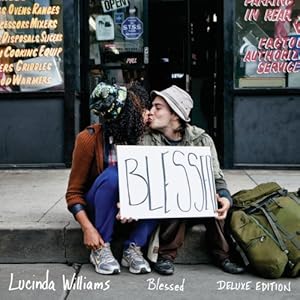
Produced by Don was of Nick of Time fame, its overall sound is pretty subdued. That's not to say it's a bad record, or that music has to be either lyrically sad and downbeat or happy and melodic (there are plenty of songwriters who've made careers with melodic angst), but there's a fuzziness I can't get past: like straining to hear or see something just out of range. Not in a physical way, but (to mix metaphors) like a fog of emotions I can't quite sort out. In that respect, It reminds me a lot of another Don Was production, Paul Westerberg's Suicaine Gratifaction.
Another thing that's been bothering me is her voice. Now, I love, love, love Lucinda's throaty rasp, but on Blessed, she sounds pretty raw. I know a singer's voice doesn't sound the same in her fifties as it did in her thirties, and some wear and tear is inevitable, but I really miss that old voice.
Aunt B. made note of some of the reviews commenting on Lucinda's recent marriage influencing Blessed's mellow sound:
Or maybe the “I got married and it mellowed me” is a good narrative because people are willing to sympathize with it. But I’m going to keep an eye out for it from here on out–the mention of a female artist’s relationships as being central to her art.The discussion on her blog is worth a read. I haven't read that many reviews other than to notice that they were overwhelmingly positive, but I've read similar things about other female artists. Though I wonder if Lucinda Williams's image as a "lone wolf" of sorts has more to do with it.
Wednesday, February 23, 2011
Listen to Lucinda Williams's Blessed

Williams also offers up a touching requiem to a good friend in "Copenhagen," in which Greg Leisz and his various guitars really shine. She contemplates and questions war — and her changing attitude toward American politics — in "Soldiers Song," for which she adopts the perspective of a solider who's far away from his young family. (Only Lucinda Williams could make the line, "Baby tells the little one / Daddy's gone bye-bye" sound unaffected and totally sincere.) And in "Born to Be Loved," she rocks a sultry blues sound, but in a surprisingly optimistic way. It's the antithesis of "Seeing Black," in which she sings, "You weren't born to suffer / You weren't born for nothing / You were born to be loved."
Thursday, December 30, 2010
Lucinda Williams Pays Tribute to the Late Vic Chesnutt
On the one year anniversary of his death, Spinner announced that Lucinda Williams's forth coming album, Blessed, will feature a track called "Seeing Black," written for the late singer-songwriter, Vic Chesnutt:
 .Here's the track list for the March 1st release, via to about.com:
1. Buttercup
2. I Don't Know How You're Livin'
3. Copenhagen
4. Born To Be Loved
5. Seeing Black
6. Soldier's Song
7. Blessed
8. Sweet Love
9. Ugly Truth
10. Convince Me
11. Awakening
12. Kiss Like Your Kiss
As [the title] suggest, Chesnutt, who was confined to a wheelchair after a car crash at age 18, struggled with more than his share of bleak thoughts. One of his last recordings, his contribution to the Dangermouse-Sparklehorse collaboration, 'Dark Night of the Soul,' was aptly titled 'Grim Augury.' Chesnutt died on Christmas Day 2009 after falling into a coma from an overdose of prescription drugs.
1. Buttercup
2. I Don't Know How You're Livin'
3. Copenhagen
4. Born To Be Loved
5. Seeing Black
6. Soldier's Song
7. Blessed
8. Sweet Love
9. Ugly Truth
10. Convince Me
11. Awakening
12. Kiss Like Your Kiss
Tuesday, November 23, 2010
Album of the Week: Lucinda Williams - World Without Tears

Not too shabby for someone with little radio airplay (in a time before iTunes, customizable internet radio stations, and youtube), and not a hit single in sight.
I chose this album for purely selfish reasons. Being a huge Replacements fan, as well as a Lucinda fan, I was thrilled that one of the songs, "Real Live Bleeding Fingers and Broken Guitar Strings" was purportedly about ex-frontman, Paul Westerberg.
But my favorites are the bluesy, sleazy "Atonement," and the odd, near rap of "Sweet Side."
I told someone once that during the 90s and 00s, when every twenty-something woman seemed to be enamored of Liz Phair or Courtney, that I didn't have a "Liz Phair," but I had a "Lucinda Williams." Flawed, but beautiful.
Tuesday, September 14, 2010
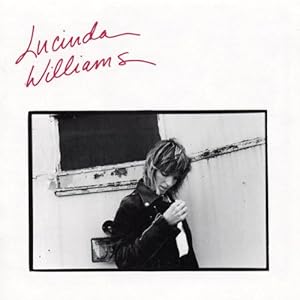
Rewind: Lucinda Williams - S/T
Saturday, July 24, 2010
The one in which I recast Lucinda Williams as a riot grrrrl (or something)

The thing is the songs on Car Wheels on a Gravel Road don't even come close to sending a positive message. She makes mistakes, falls in with the wrong crowd, falls in love with the wrong guy, drinks too much... she's deeply flawed. And for all her tough cooke posturing, I get the feeling she would leave it all if a "good man" came around. These were not the values I was supposed to be learning, but it felt real. I know that sounds cliche: "It's so real," Or "it's so raw." I have to roll my eyes when rock fans describe their favorites as "raw," but it is. Like, open up a wound, raw. But it doesn't sound out of place next to those other iconic female artists of the 90s. Lucinda never compromised her artistic integrity either.
Something else I find exasperating? When albums are held up as "universal." This is the real issue I have with the rash of 90s nostalgia. A lot of those "universally" love albums and the culture surrounding them smacked too much of elitism: grass roots punk movements that started and ended on college campuses. Oddly enough, Lucinda Williams came from an academic background. Her father was a poet and professor, but her music was neither "painfully intellectual" nor inaccessible.
One of the best reviews I read of a (now forgotten) album went something like, "I judge an album by how it makes me feel. If it makes me feel good, then it is good." Car Wheels on a Gravel Road makes me feel good -- and I'm okay with that cliche.
Sunday, May 16, 2010
Lucinda Williams as part of the 33 1/3 series
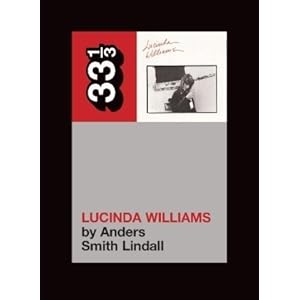
"The album was recorded over just a few days in a tiny Santa Monica studio, but was really the fruit of an intense three years in the life of a then-unknown songwriter and her band, playing tiny L.A. dives, building up a local following, and honing their songs. In those years, Lucinda says, "a magical thing happened". The result, from a songwriter's standpoint, was one of the great records of the last 25 years. The disc is packed with vivid characters - most of them tough, wise, and romantic, and sometimes uncertain working-class women not unlike Lucinda herself."
Subscribe to:
Posts (Atom)